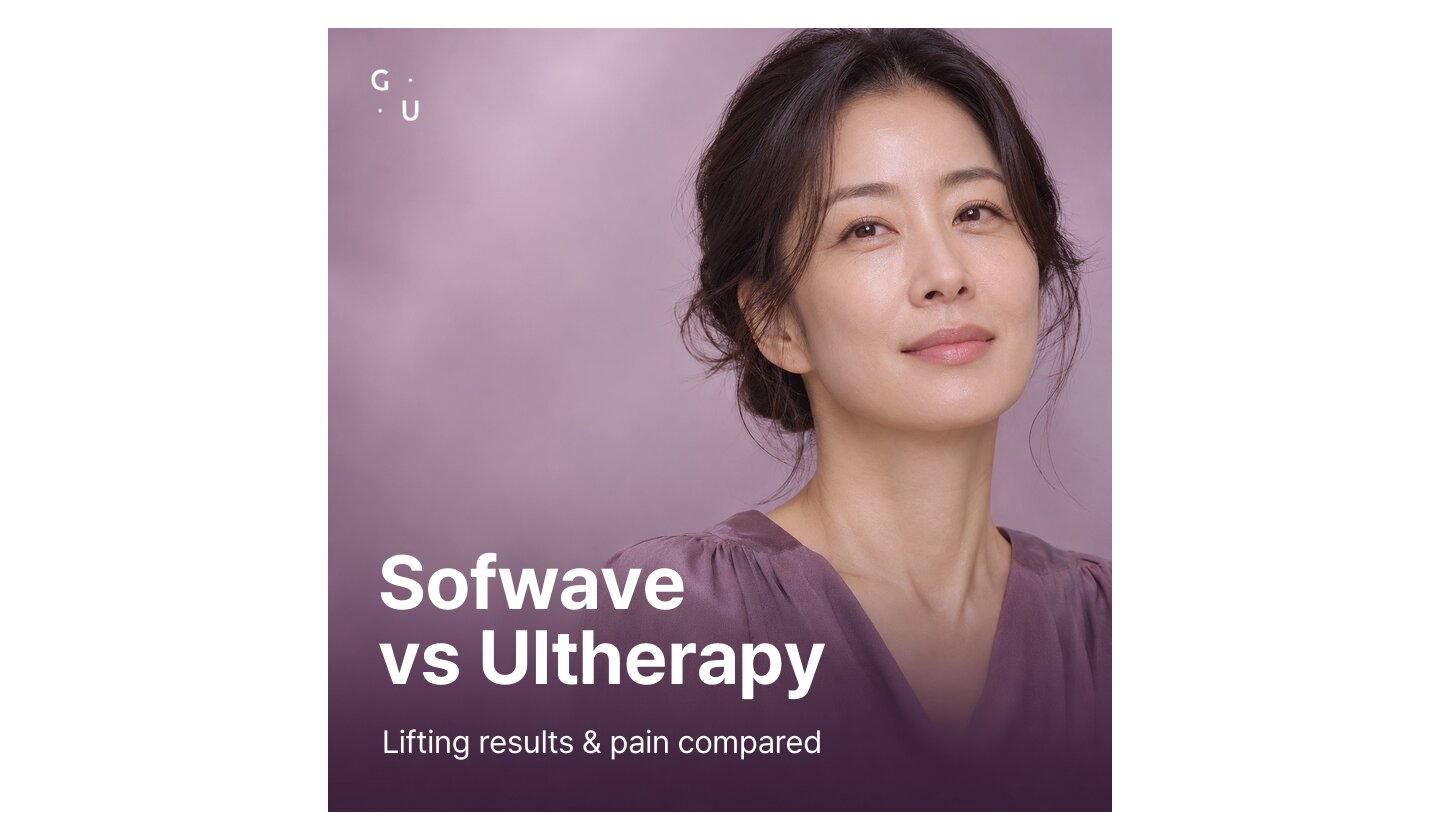
Sofwave vs Ultherapy Lifting: Results and Pain Compared
Written by Ki Bum Park · Chief Director
Compare Sofwave and Ultherapy for fine lines and early jowls, including expected results, treatment timelines, pain, and individual differences.
As fine lines become more noticeable and your jawline loses definition, you may start looking into Sofwave and Ultherapy. How much a treatment hurts can matter just as much as whether it works. Sofwave uses heat to stimulate the layer that supports the skin, helping reduce fine lines and improve firmness. Ultherapy uses imaging to select treatment depths and is used to lift sagging tissue. Both treatments produce changes over several months, and the pain you experience depends on the treatment area and settings.
Which skin concerns can they address, and how do they work differently?
Sofwave and Ultherapy use ultrasound to heat tissue and stimulate changes in collagen without cutting the skin. The features to consider first depend on whether your main concern is fine facial lines and reduced firmness or whether you want to lift loose skin under the chin and on the neck.
If fine lines and skin that feels less firm are your main concerns
Sofwave may be an option. Sofwave delivers multiple ultrasound beams in parallel to heat the dermis. The dermis contains collagen and other structures that support the skin. Heating this layer is intended to reduce fine lines and make the skin firmer. The skin's surface is cooled at the same time to protect it; we compare the heat and pain you may feel during treatment below.
If loose skin under your chin or on your neck is your main concern
You can consider a lifting plan with Ultherapy PRIME. Ultherapy focuses ultrasound energy at small points at selected depths beneath the skin to heat the tissue. Real-time imaging shows the skin and underlying tissue, allowing treatment depths to be selected according to the thickness and location of tissue in each area. Adjusting the depth helps tailor treatment to sagging areas under the chin or on the neck.
If you have both fine lines and early jawline sagging
Sofwave is also used to improve facial wrinkles and lift lax tissue around the eyebrows, under the chin, and on the neck. The uses of the two treatments overlap, so it is important to compare the changes you can expect in the same area.
Early jowls develop when the lower cheeks beside the mouth descend and make the jawline uneven. This affects a different area from loose skin directly under the chin. Facial contours can change as skin loosens or facial fat decreases and shifts position. If your lower cheeks are your concern, it is important to assess whether reduced skin firmness or sagging tissue is the main cause. The changes you can expect from Sofwave and Ultherapy PRIME depend on your skin condition and the degree of sagging. When skin is very loose or sagging is pronounced, changes to the jawline or facial contours may be limited. Results may differ from those of surgery that repositions tissue and removes excess skin.
When do results appear, and how long do they last?
For both treatments, it is important to look at changes over the following months rather than only immediately afterward. Results develop gradually as collagen changes, generally over about 12 weeks with Sofwave and about 2–3 months with Ultherapy. The point when you first feel tightness may differ from when you can see changes in wrinkles or sagging. How long those changes last is a separate consideration.
| What to compare | Sofwave | Ultherapy PRIME |
|---|---|---|
| Main changes to look for | Reduced fine facial lines and improvements in skin firmness and sagging | Lifting of sagging tissue under the chin or on the neck and improved firmness |
| When changes become noticeable | Some early changes may be noticeable within 1 week, with gradual changes over about 12 weeks | Some initial lifting may be noticeable, with the main results developing gradually over about 2–3 months |
| How long results may last | Results from a single treatment may last a year or longer | Results from a single treatment may last a year or longer |
| Sensations during treatment | Heat and pain where energy is delivered | Heat, tingling, and pain as energy is delivered |
| Factors affecting results and pain | Skin condition, age, lifestyle, treatment area, and intensity | Tissue thickness and degree of sagging, as well as the treatment area, depth, and intensity |
With Sofwave, changes continue gradually over about 12 weeks after the initial changes, while Ultherapy's main results develop over about 2–3 months. Comparing Sofwave's “some changes within 1 week” with Ultherapy's “main results after 2–3 months” to decide which is faster compares different stages of the response. Compare results at the same point after treatment. It helps to assess reduced fine lines, firmer skin, and improvement in sagging separately.
Your skin continues to age and respond to lifestyle factors after treatment. How loose your skin was initially and which areas were treated affect the visible changes and how long you remain satisfied with them. Because the duration of results varies from person to person, the timing of maintenance treatment is based on the remaining effects and your skin condition at that time.
If you are having treatment during a visit to Seoul, distinguish the length of your stay from the time it takes for results to develop. During a stay of a few days, you will mainly see the skin's immediate response, while changes in wrinkles and firmness may continue after you return home. If you want results for an important photo shoot or event, allow time both for swelling to settle and for results to develop gradually when scheduling treatment.
Which hurts more during treatment: Sofwave or Ultherapy?
The pain you feel depends on the treatment area, intensity, and pain relief methods used. Here are the sensations you may experience with each treatment and ways to reduce discomfort.
- Sofwave: You may feel heat building in the skin, and significant pain or tenderness may also occur. Cooling protects the skin's surface, while topical anesthetic applied before treatment or adjustments to intensity help reduce discomfort. Even with these measures, you may still feel heat being delivered beneath the skin.
- Ultherapy: You may feel heat or tingling as energy is delivered. Even for the same person, discomfort varies with the treatment area, depth, and intensity. The areas where energy will be delivered are planned for the treatment site, and intensity can be adjusted to reduce discomfort while continuing the planned treatment.
At GU Clinic, intravenous pain relief is available as a separate option for Ultherapy PRIME treatment. Let us know during your consultation if you are concerned about pain. We will review your health and medication history and discuss whether this option is appropriate for you.
Pain sensitivity also varies from person to person. Knowing which areas were particularly painful during similar treatments, or whether you experienced discomfort after anesthetics or pain medication, helps us plan pain management.
If pain becomes intense during treatment, tell the medical team right away so they can adjust the intensity and how treatment proceeds. You do not need to use the amount of pain you can tolerate as a measure of effectiveness. The treatment area and depth are selected, and intensity and treatment delivery are adjusted according to the discomfort you feel.
Can pain or swelling remain after treatment?
The brief heat you feel during treatment is different from tenderness when you press or touch the area afterward. Both Sofwave and Ultherapy can cause redness, swelling, and discomfort. An area may feel sensitive to touch even if there is little visible change.
After Sofwave, mild redness or swelling may subside within a few hours. However, redness or swelling may last longer, and tenderness, bruising, or changes in skin color can also occur. Since swelling can persist, it is best to leave some time between treatment and important plans.
After Ultherapy PRIME on the face or neck, different symptoms may last for different lengths of time.
- Mild swelling: Usually resolves within 3–72 hours.
- Post-treatment discomfort: May last for about 2 hours to 2 days.
- Tenderness when pressing or touching the area: May last for about 2 days to 2 weeks.
Bruising or temporary changes in sensation may also occur. How long symptoms last varies, so pay attention to whether they are gradually improving as well as how long they persist.
Contact the clinic that treated you for an assessment if severe pain persists or worsens, if blisters or wounds develop, or if you notice changes in sensation or facial movement. Returning to daily activities does not necessarily mean all symptoms have resolved, so follow your medical team's aftercare instructions during recovery.
At GU Clinic, we take the length of your stay into account when scheduling treatment and aftercare for visitors from abroad. Let us know during your consultation if you have a departure date, important photo shoot, or event coming up. We confirm your treatment plan after assessing your skin at our Gangnam main location.
How can you decide while considering results, pain, and recovery?
If both treatments are options, compare them in this order.
- Identify the area and change you want to address. Decide what you want to improve in the area that concerns you most, and check whether the treatment fits that goal.
- Discuss pain management. Tell us which areas have been painful before and about your experience with anesthetics or pain medication. Ask about available pain relief methods and how intensity and treatment delivery can be adjusted if you feel uncomfortable during treatment.
- Plan recovery around important dates. Allow for the possibility of lingering swelling or tenderness and the time it takes for results to develop. Schedule treatment around your photo shoot or event and the time you can set aside for recovery.
Sofwave and Ultherapy PRIME options at GU Clinic
At GU Clinic's Gangnam main location, we offer Sofwave and Ultherapy PRIME. Both treatments have options based on shot counts, and Ultherapy PRIME also has a separate option for the eye area.
| Treatment or option | Available options | What to consider when choosing |
|---|---|---|
| Sofwave | 100, 200, or 250 shots | The number of shots and the areas to be treated are planned together |
| Ultherapy PRIME | 300 or 600 shots | The treatment areas, depths, and distribution of shots are planned together |
| Eye Ultherapy PRIME | 200 shots | A separate option for the eye area |
| Ultherapy PRIME pain relief add-on | Intravenous pain relief injection | An optional add-on selected separately from the base treatment |
The two devices deliver energy differently and treat at different depths, so shot counts alone cannot be converted into equivalent treatment amounts. Similarly, 200 shots for the eye area serve a different purpose from 200 shots elsewhere.
These options were confirmed on November 17, 2026. Current options and prices are available on our Sofwave treatment page and Ultherapy PRIME treatment page.
Consultation checklist
- In my case, should the main treatment goal be improving fine lines, early jowls, or sagging under the chin?
- Which areas and depths will be treated, what pain should I expect, and how can it be managed?
- Are the pain relief options suitable for me, considering my health and medications?
- Which symptoms after treatment should prompt me to contact the clinic, and when should I have my progress checked?
Frequently asked questions
Can I see changes after just one Sofwave or Ultherapy treatment?
Changes can be expected after a single treatment. Additional sessions may be needed depending on your skin condition and goals. The timing of the next treatment is decided after considering the changes that develop over the months following your first session.
Can I have treatment if I have previously had fillers?
Tell your medical team where and when you had fillers and which product was used. Sofwave is not recommended directly over areas containing dermal fillers. Ultherapy is also not recommended directly over areas containing dermal fillers. For both treatments, the location of existing fillers must be assessed in relation to the intended treatment area.
Related reading
Written by
Ki Bum ParkChief Director
Care is led by Chief Medical Director Ki-beom Park.
- B.S. in Biotechnology, College of Engineering, Yonsei University
- Graduate of Yonsei University Graduate School of Medicine
- Adjunct Professor, Graduate School of Integrative Medicine, CHA University
- Co-founder of Gangnam Unni, a medical aesthetics information platform
- Operator of Healing Breeze, a medical service organization (MSO)
- Developer of GENABELLE, a K-Derma cosmetics brand
- Developer of the CELLORA of GU brand
GU CLINIC · GANGNAM
Find the right treatment. Start with a consultation.
Discuss skin boosters, skin tightening, botulinum toxin injections and dermal fillers at GU Clinic in Gangnam, Seoul. Ask about treatment options, costs, recovery time and planning your visit.
사적인 아름다움, 치유 클리닉

Personal Beauty GU Clinic — Gangnam Main Branch
Advanced Regenerative Medical Institution designated by the Korean Ministry of Health and Welfare
Designation No. 재생-1-0036
25 doctors, including board-certified specialists in plastic surgery, dermatology and family medicine
Consultation languages: Korean · English · Chinese (Simplified & Traditional) · Japanese
Location & directions
3F & 4F, W Tower, 54 Seocho-daero 77-gil, Seocho-gu, Seoul
About a 1-minute walk from Sinnonhyeon Station Exit 7About a 7-minute walk from Gangnam Station Exit 10
Ilsan branch also in operation
Location & directionsOpening hours
- Weekdays
- 10:30–21:00
- Weekends & public holidays
- 10:30–19:00
Closed on Seollal and Chuseok day
+82-2-6241-0096This article provides general information about treatments. Treatment results, recovery and side effects vary from person to person. Please consult a medical professional before deciding on treatment.