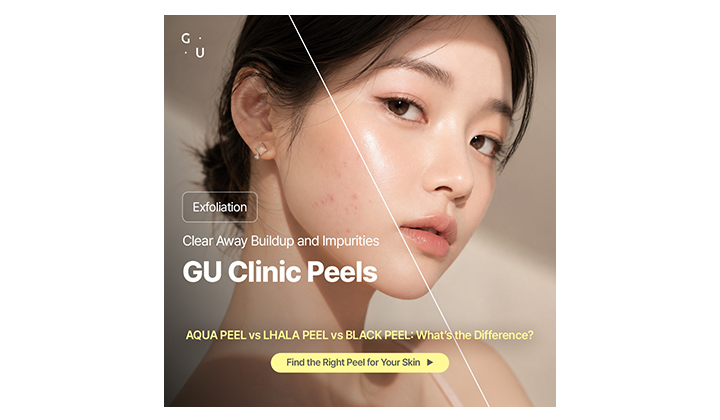
Exfoliation
Clear Away Buildup and Impurities
GU Clinic Peels
AQUA PEEL vs LHALA PEEL vs BLACK PEEL: What's the Difference?
Find the Right Peel for Your Skin ▶
Aqua, LHALA & Black Peels in Seoul
Explore how Aqua, LHALA, and Black Peels work and which skin types they suit. Find the right option for pore cleansing and overall skin care.
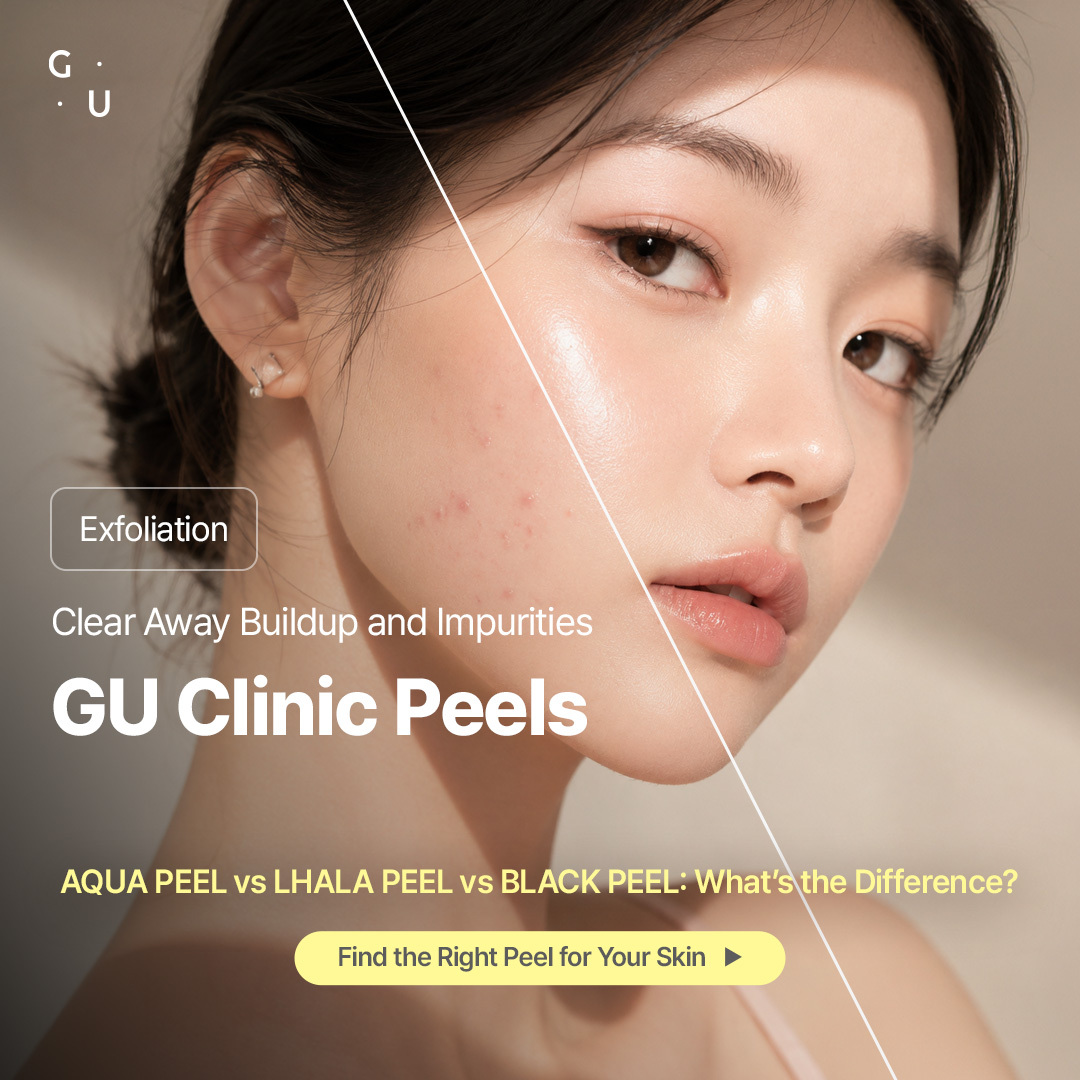
Exfoliation
Clear Away Buildup and Impurities
GU Clinic Peels
AQUA PEEL vs LHALA PEEL vs BLACK PEEL: What's the Difference?
Find the Right Peel for Your Skin ▶
When your pores suddenly feel clogged, makeup that normally applies
smoothly may begin to look patchy, and breakouts can appear more easily.
Seasonal transitions and environmental changes can leave the skin’s surface rough,
allowing excess sebum and dead skin cells to collect inside the pores.
This may contribute to the development of whiteheads and blackheads.
If the buildup continues, it may lead to breakouts or create an environment
in which Demodex mites can proliferate.
For this reason, peeling treatments should be selected
according to your current skin condition and type.
A treatment suited to your skin helps reduce
unnecessary irritation while providing more effective care.
Today, we will compare Aqua Peel, LHALA Peel, and Black Peel,
each of which works differently, and explain which option may suit your skin concerns.
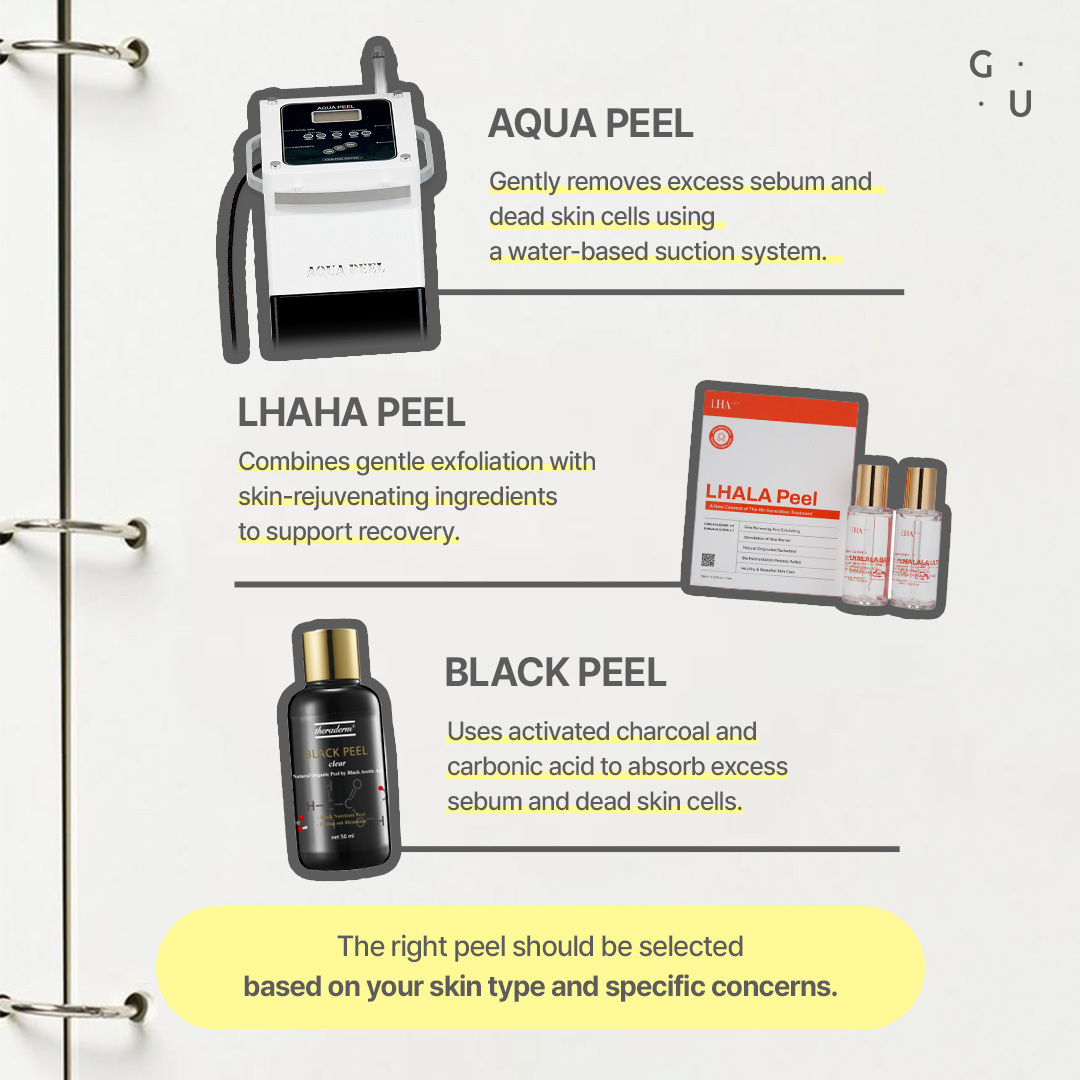
| Treatment Name | Description |
|---|---|
| AQUA PEEL | Gently removes excess sebum and dead skin cells using a water-based suction system. |
| LHAHA PEEL | Combines gentle exfoliation with skin-rejuvenating ingredients to support recovery. |
| BLACK PEEL | Uses activated charcoal and carbonic acid to absorb excess sebum and dead skin cells. |
The right peel should be selected based on your skin type and specific concerns.
"Aqua Peel, LHALA Peel, and Black Peel:
What’s the Difference?"
- Aqua Peel: For Blackheads and Congested Pores
Aqua Peel uses solutions containing ingredients
such as AHA and BHA to loosen surface buildup and excess sebum.
Controlled suction then helps remove the loosened debris from the pores.
It may be helpful when pores feel congested after frequent sunscreen
and makeup application, or when blackheads and excess oil become more noticeable.
However, suction strength should be reduced on thin or easily flushed skin.
Excessive pressure may cause temporary redness or minor bruising.
- LHALA Peel: Gentle Care for Rough Skin Texture
LHALA Peel may be considered when you want to improve rough texture and dullness
but are concerned about aggressive exfoliation or visible peeling.
Instead of harshly stripping the skin’s surface,
it is designed to gently refine accumulated dead skin cells
while supporting a smoother, more hydrated, and radiant-looking finish.
A gentler treatment does not automatically mean
it is suitable for every sensitive skin type.
If your skin barrier is compromised or you currently use retinol
or exfoliating acids, your skin condition should be assessed before treatment.
- Black Peel: For Recurring Oiliness and Breakouts
Black Peel is an acid-based treatment generally used for oily
or combination skin affected by excess sebum, recurring congestion, and breakouts.
Common Black Peel protocols include salicylic acid,
although the exact formulation and application method may differ between clinics.
As a form of chemical exfoliation, it may cause
temporary stinging, dryness, redness, or light flaking.
Careful assessment is needed when active inflammatory acne,
open wounds, or a damaged skin barrier is present.

"A Quick Comparison by Skin Concern"
Main skin concerns | Treatment method | What you may expect | |
|---|---|---|---|
Aqua Peel | Blackheads, excess sebum, and pore buildup | Pore cleansing with peeling solutions and controlled suction | Cleaner-looking pores and smoother skin texture |
LHALA Peel | Rough texture, dullness, and sensitivity to stronger peels | Gentle exfoliation with hydration-focused care | Refined texture with less visible peeling |
Black Peel | Excess oil, recurring congestion, and breakouts | Acid-based peeling selected for oily skin | Reduced surface buildup with possible temporary dryness |
This comparison outlines the general role of
each facial peel available in Seoul and Gangnam.
However, one person may experience breakouts,
an oily T-zone, and sensitive cheeks at the same time.
In these cases, applying the same method across the entire face may not be appropriate.
Skin responses may also differ depending on the solutions used,
their intended purpose, suction strength, contact time,
and finishing care—even when the treatment has the same name.
Rather than choosing by name alone,
ask how the treatment will be adjusted for your current skin condition.
Come as you are
"Which Peel Should You Choose?"
Aqua Peel may be considered when blackheads and pore buildup are your main concerns.
LHALA Peel may suit skin that needs gentle texture care,
while Black Peel may be selected for excessive oiliness and recurring congestion or breakouts.
Before deciding, your current sebum levels, pore condition,
and skin barrier should be evaluated.
The type of peel, treatment intensity,
and post-treatment soothing care can then be tailored to your skin.
✨Discover Peeling Treatments for Smoother Skin✨
This has been Glow Up Clinic.
Thank you for reading.
Dr. Ki-beom Park(Chief Medical Director) - B.S. in Biotechnology, College of Engineering, Yonsei University - M.D. Yonsei University College of Medicine - Adjunct Professor, Graduate School of Integrative Medicine, CHA University - Co-founder of Gangnam Unni, a medical aesthetics information platform - Operator of Healing Breeze, a medical service organization (MSO) - Developer of GENABELLE, a K-Derma cosmetics brand - Developer of the CELLORA of GU brand |